Pug's Kitchen

Telling the stories while sharing the recipes

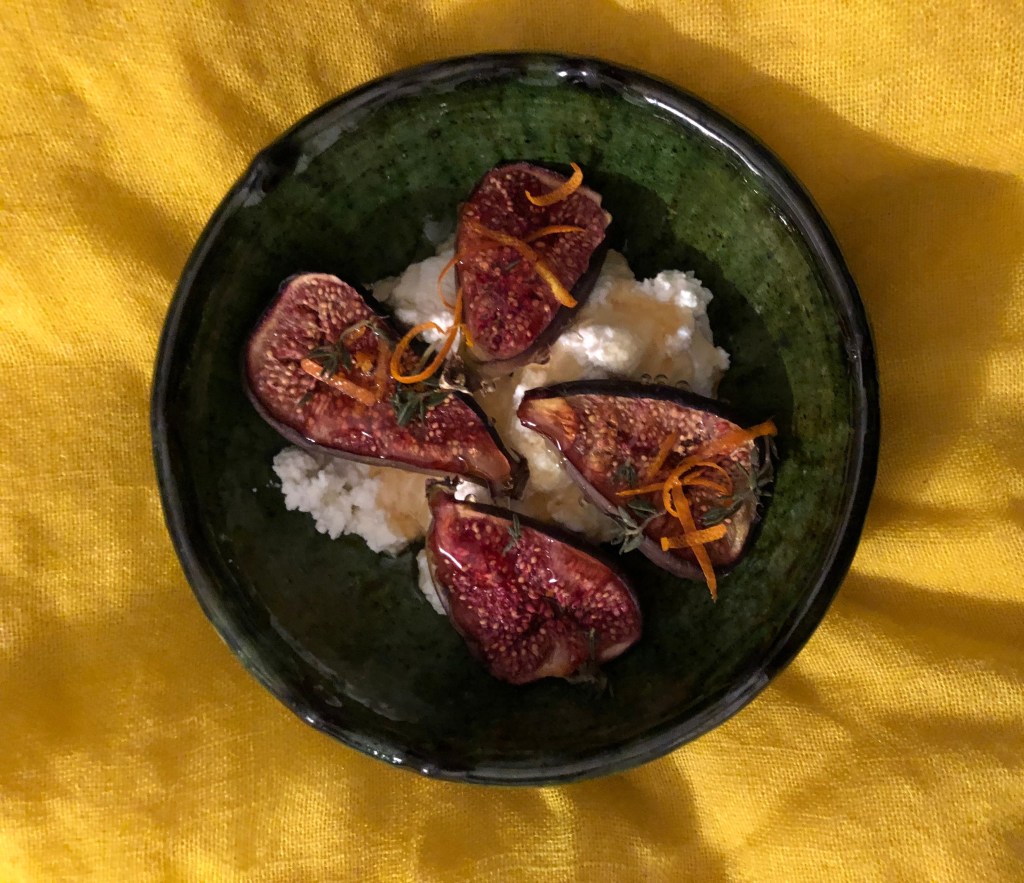
  • Jammy figs for the bleak midwinter

    We all know what it’s like in the UK in winter… cold, dank and, more often than not, it’s dreich.

    London, in the mid-winter… there be lots of trees and no leaves

    This really really simple dish is guaranteed to take you back to any Mediterranean holiday where it’s warm, relaxed and with a whiff of the sea in the air.

    Ideally you need to be using over-ripe figs; the ones that you fear may burst when you touch them. However, this is Britain, mid-winter, so we make do with the smaller variety. If using these you’ll need to sweeten them up a little, so I’ve given you the obvious and easiest way of doing this

    The result of this gives you sticky, jammy-rich figs with an easy-earthiness provided by the herbs and a zing from the orange zest. They keep for a few days and are great as a cheese course with matured and hard pecorino or for breakfast with ricotta cheese and honey or apricot jam.

    Music to prepare this dish to: ‘Summertime’ by Ella Fitzgerald

    Ingredients

    • Figs (enough to cover an oven shelf when halved)
    • Handful fresh thyme leaves
    • Zest of two large oranges (use a zester for fine ribbons not a grater)
    • Runny honey (for not-bursting-with-ripeness figs)

    Method

    1. Preheat oven to 60 degrees fan (the lowest heat you have).
    2. Remove the stalks and cut the figs in half.
    3. Arrange on a wire rack and cook in the centre of the oven for 2.5 hours.
    4. 15 mins before you switch the oven off, sprinkle over the thyme and the orange zest. Pop the figs back in the oven for the last 15 mins.
    5. If using the really ripe figs, you can eat straight away. Those you aren’t eating, leave in the cooling oven overnight. The residual heat will just make them more sticky as your oven cools down.
    6. If using young figs, after the cooking time, remove the figs to a lasagna dish or equivalent, and drizzle with the runny honey. Pop them back in the cooling oven for an extra 10 mins before serving. Any left over can stay in the dish, in the cooling oven, overnight.

    These go really great with a dense Oloroso sherry – the nutty notes bounce with the orange and settle nicely with the thyme while its caramel underbelly plays nicely with the figs.

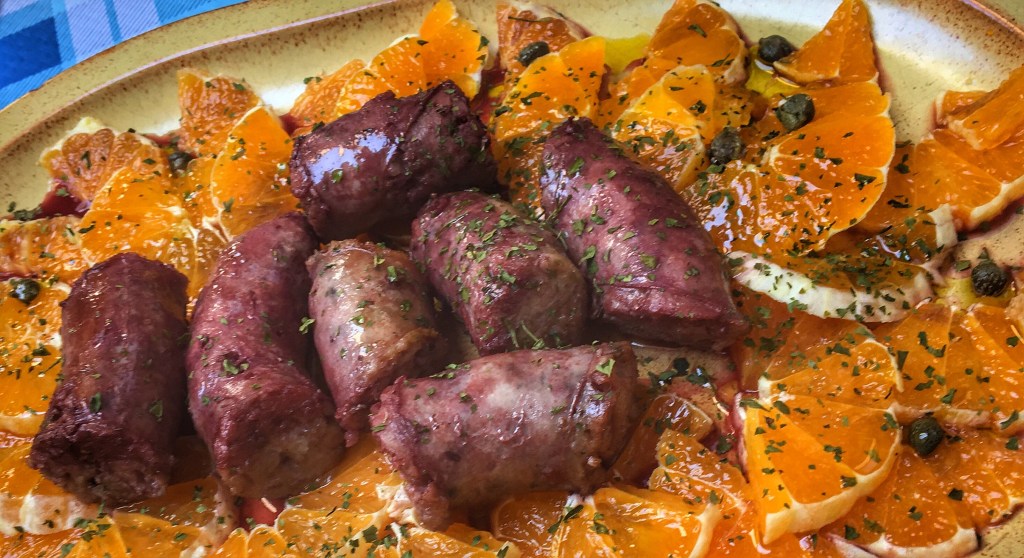
  • Italian Sausage on orange and caper salad

    Fully refreshed after two Mediterranean breaks in quick succession, I am inspired. One of my breaks was in Sicily and this recipe is classically Sicilian; marrying the best of the region in one simple dish packed full of unusual combinations.

    orange_fennel
    The vegetarian alternative for this dish – just as tasty

    We headed to Modica, a crowded, tightly packed town full of Baroque charm, Aztec recipe chocolate and charm. I discovered this dish when the other half and I discovered a courtyard tavola calda (a small restaurant with a small, locally-sourced menu) to escape the 45-degree heat. Don’t be put off by the combo – it’s delicious.

    We were staying with a vegetarian which is why I created the fennel version for the non-meat eaters.

    Music to listen to while preparing this dish: ‘Human’ by Rag’n’Bone Man 

    Ingredients

    • 2 large ripe sweet oranges
    • 1 tablespoon capers in brine (or 1/2 teaspoon of salted capers chopped)
    • Heaped teaspoon of chopped fresh thyme
    • One large Italian pork, fennel and chilli sausage (they come in rounds)
    • Splash of Nero d’Avola wine
    • Or one large fennel sliced (veggie options)
    • Salt and pepper
    • Chilli (if going veggie)

    Method

    1. Pan fry the sausage, making sure you get a good colour all the way round.
    2. With a large sharp knife, peel and slice the oranges into rounds and arrange on a large platter.
    3. Sprinkle the capers and fresh thyme over the oranges then season lightly with salt and pepper.
    4. Once the sausage is cooked, remove from the pan and chop into 2″ size pieces.
    5. Keep the pan on the heat and deglaze the pan with the Nero d’Avola wine
    6. Add the sausages to the wine, toss and then add on top of the orange salad.
    7. If going veggie, coat the fennel pieces with olive oil and season with the salt, pepper and chilli.
    8. Grill until cooked, turning regularly and the fennel has started to brown.
    9. Add to the top of the orange salad

    Serve with the Sicilia Nero d’Avola wine you opened for this recipe.

  • Jarod’s herring, beets & dill

    My other half is a personal trainer, massage therapist and the brains behind Kamikaze Angel, the grooming artillery for men. This keeps him busy, all day, most days and in need of a good, quick-to-put-together feed at the end of the day.

    jarod_cowboy

    Jarod on the stairs of the First Floor in Notting Hill. The restaurant’s now gone, but the good times there live on …

    This is another great dish of his that is quick and easy to assemble; there’s no culinary expertise here except Jarod’s defined palate that created it. If you can get them, get fresh herring, failing that, mackerel works really well. The key here is the fish has to be fresh, whole and oily.

    When we made the beet sides for this dish, I made a classic vinaigrette – that was a mistake. You need a creamy sauce to bind it all together and carry the dill through the vegetables. The mayonnaise dressing does just the job.

    This is for two people but can be scaled up easily

    Music to prepare this dish to: ‘Monkey man’ by Amy Winehouse with Jools Holland

    Ingredients

    • 2 whole North Sea herring (cleaned)
    • 1 lemon sliced
    • 1 bunch of dill
    • 200g cooked beetroot (either fresh or from a vacuum pack – not in vinegar)
    • 200g fine green beans trimmed
    • 200g fresh shelled peas

    For the dressing

    • 3 tablespoons mayonnaise
    • 1 teaspoon Dijon mustard
    • 1 tablespoon chopped dill (taken from the pack above)

    or

    Method

    1. Preheat oven to 180C.
    2. Divide the dill, whole between the two fish and stuff in the cavity of each. Remember to have kept some back for the sauce.
    3. Arrange the lemon slices on top of the herring and put any extra in to the fish cavities with the dill.
    4. Season and wrap into a foil parcel and bake for 20 to 25 mins.
    5. While they’re cooking, blanche the green vegetables for five minutes.
    6. Once cooked, run until a cold tap until cold, shake and cut the beans in half. Dry off with kitchen roll and add all the greens to a bowl.
    7. Chop the beets into bite-size pieces and add to the greens.
    8. Now season as the beets in particular need a whack of salt and pepper.
    9. Mix the ingredients for the dressing together, add to the vegetables and ensure everything is covered evenly.
    10. By this time the fish should be cooked, so all you have to do is plate up.

    Serve with a cold Anthilia Donnafugata from Sicily to cut through the richness

    Assembly in two images

    herring_prep
    Ready, seasoned, stuffed with dill, topped with lemon…. only 25 mins from the table
    herring_done
    And 25 minutes later, it’s ready. This shows the beets with a vinaigrette… that was a mistake, use the mayonnaise dressing instead
  • Fabien’s cured/smoked ham with lentils

    Fabien (Babu) is a soul brother who I met in my final year at uni when he started dating my housemate – a year later the three of us moved to Paris and had a ball in the world’s most beautiful city.

    Fabien in his favourite place - the kitchen

    Fabien in his favourite place – the kitchen

    We lived in a duplex apartment in the Marais and while Nathalie found work relatively easily, it was tougher for us. During the down times, Babu and I used to wake late, watch music TV (the Spice Girls were everywhere) and went for monumental walks around the city. We used to share a sandwich américain – a full baguette filled with fries, steak hachés and topped with a light Dijon mustard mayonnaise – before looping back to the house, stopping for a beer and feigning ‘tough-day-job-searching’ faces for when Nathalie got home. We rarely fooled her.

    The upside was I got to know Paris very well. The bedside I was poor.

    Dinner duties usually fell to me and Babu – it was only fair – and this recipe for Petit salé aux lentilles (ham hock with lentils) pas a staple. It’s a one-pot dish that takes a few hours to prepare, costs very little to make and lasts forever.

    Music to listen to while preparing this dish: ‘Aïcha’ by Khaled

    Ingredients

    • 1kg cured ham joint – some people choose belly, knuckle is great (and traditional), I often smoked gammon joints as they are easy to get hold of quickly
    • 2 bay leaves
    • 2 sprigs thyme
    • 2 cloves garlic, peeled
    • 2 large carrots cut in to batons
    • 2 sticks celery cut into batons
    • 1 large onion, sliced
    • 400g Puy lentils
    • 500ml light chicken stock (it really has to be light – especially on the salt content)

    Method

    1. Put your joint in a large pan, cover with cold water and bring to boil. Simmer the joint for one hour, then drain and rinse with cold water.
    2. Once cool, trim the joint of excess skin and fat and leave to one side.
    3. Gently heat a generous amount of olive oil in a pan and sweat down the onions and garlic. Be careful not to colour them, you just want them slightly translucent.
    4. Add the carrots and celery and gently fry off for a further five minutes.
    5. Add your lentils and fry with your veg for a good couple of minutes.
    6. Return the ham to the pan and top up with the stock and add your herbs.
    7. Simmer for between 30-40 minutes on a medium heat until your lentils are cooked. Check your water levels after 30 mins and top up if necessary.
    8. Once your lentils are cooked and have absorbed most of the liquid, discard the bay leaves and thyme twigs, remove the ham, shred it and return it back to the stew.

    Serve with good Dijon mustard, crusty bread and a medium white wine.

  • Tagliata for Sarah (aka Drag Queen steak)

    Sarah is my partner Jarod’s best friend. Sarah got married in Modica, Sicily and threw a three-day bash where she spoilt each and everyone of us with food, booze and trips to the beach.

    Show time at Sarah's wedding breakfast in Modica

    Show time at Sarah’s wedding breakfast in Modica

    We spoilt her with a drag show full glitter, glamour and polyester wigs. You’ve not known fear until you’re confronted with three hairy gays in gold lame looking at you for their cue with love in their hearts and murder in their eyes lest you cock up.

    This medium rare steak dish is the first thing Jarod and I ate when we arrived for the wedding and like all things Italian, it’s based on a few, very basic ingredients. It’s a crowd pleaser and because of how it’s served, it goes a long way.

    This is for 8 people and is great with roasted diced potatoes.

    Music to list to while preparing this dish: ‘Single ladies (Put a ring on it)’ by Beyonce

    Ingredients

    • 4 Sirloin steaks (about 300g and 5cm thick each). These need to be Sirloin and they really have to be at room temperature.
    • 125ml olive oil
    • Handful of herbs of your choice, chopped. I like mixing it up but usually go with rosemary and thyme, sometimes with chilli, often with a lot of black pepper. You can use oregano, marjoram, or dill for the brave. Some like garlic, I don’t. It really is your choice, but whatever you use, make sure it’s fresh if possible.
    • A tablespoon of capers drained
    • Salt & pepper
    • Juice of a medium lemon
    • A large bag of lambs lettuce or two small ones – avoid rocket, it’s a powerful leaf that can overpower the steak and the aromatics.

    Method

    1. Heat a good plug of olive oil in a heavy-bottomed pan, and wait till it is smoking hot. Now fry your seasoned steaks. The best way to serve tagliata is medium rare so fry for a maximum of 3 mins (so 90 secs each side). Get a good colour, some charring won’t hurt.
    2. Once cooked, leave to rest. Make sure you cover the steaks to keep them warm.
    3. Lower your hob to a very gentle heat. Now in the pan add your oil, your aromatics/herbs, salt and pepper and let stew for 3-4 minutes. After this add the lemon juice, mix and remove from the heat.
    4. Slice your steaks (‘tagliata’ means slice) thinly – about 1cm to 1.5cm thick
    5. On a large serving platter or dish, scatter the lambs lettuce and arrange your steak strips over the top.
    6. Pour over the oil/herb ‘dressing’ and scatter the capers over the top.

    There’s only one thing to serve with steak – a classic martini. Gin is my choice, vodka will do.

  • Neither hurried nor harried eggs

    Until I met Jarod, I was never a big egg eater, with fried eggs being a particular challenge. Jarod inhales eggs any which way they come.

    There’s a myth that scrambled eggs are quick and easy to make. That’s half true. Easy? Yes. quick? No.

    If you knock up scrambled eggs in under five minutes, you’ve done the humble egg a great disservice.

    cheers

    Cheers! This is my Sunday best/Wedding/Smarter-than-Average party outfit

    The key with these scrambled eggs is in the cooking. The very, very slow cooking and this recipe draws on the lessons of MFK Fisher who said that scrambled eggs ‘will not succeed if the cook is either hurried or harried.’

    If you’re looking for a quick fix, this ain’t it.

    You’ll want and need eggs with a strong bright yolk… the results look much better for them.

    This is for one person, just scale up.

    Music to prepare this dish to: ‘Gotta pull myself together’ by The Nolans

    Ingredients

    • 1 large knob unsalted butter
    • 2 large eggs. As mentioned above, the yolk is key and I’ve just discovered Burford Browns
    • Either 3 tablespoons double cream (my preference) or a heaped tablespoon crème fraîche (MFK Fisher’s preference though too sour for me)
    • 1 teaspoon Maille Dijon mustard
    • Salt and pepper to taste

    Method

    1. Place a wide frying pan over a very low heat and melt the butter.
    2. While the butter melts, mix the cream and mustard until well combined.
    3. Add the two eggs and loosely beat. You want to see streaks of yellow and not a homogenous blend. Season with the salt and pepper.
    4. Pour the mix into the pan with the melted butter and gently stir with a spatula in huge figures of 8. Slowly, assuredly and over and over again.
    5. You’ll be tempted to up the temperature. Don’t.
    6. Just. Keep. Stirring.
    7. After about 15 minutes the eggs will start to cook, keep stirring until there is a mass of eggs with some runny bits all the way through. Because you’ve taken the time, you’ll have fluffy, wavy eggs.
    8. Serve with buttered toasted sour dough and heaps of smoked salmon.

    Eat with Prosecco – you deserve it for being so patient because by the time you’ve made this it’s past breakfast and time for brunch

  • Coronation roast chicken for HM

    I dreamt this dish up an aeon ago, but my lazy sorry arse has only just got round to typing it up. I created it for a royal occasion for which we were having a dinner to celebrate and there’s nothing better no more British than Coronation Chicken.

    The finished dish… just make sure you chop the coriander more finely

    Coronation Chicken was the brainchild of Constance Spry, a food writer and Rosemary Hume, a chef from the  Cordon Bleu Cookery School in London. They conjured it up for a banquet to celebrate the Coronation of Queen Elizabeth in 1953.

    Their recipe is for a cold dish – basically chicken, curry and mayonnaise… Mine marries it with the traditional roast and minuses the mayonnaise. The creaminess comes with the sauce.

    Music to prepare this dish to: ‘Killer Queen’ by Queen

    Ingredients

    • I medium chicken
    • 2oz Sultanas
    • One huge glug white wine
    • 3oz salted butter
    • 3 heaped teaspoons mild curry powder
    • Dijon mustard
    • Salt and pepper
    • Zest and juice of one lime
    • Toasted flaked almonds
    • A few stems of coriander, chopped

    Method

    1. Heat oven to 180 degrees.
    2. Bring wine to the boil, remove from the heat  and throw in the sultanas. Let them steep in the wine for a good 10 mins until the wine is cool.
    3. Cream the curry powder and butter until evenly mixed.
    4. Pinch the skin of the chicken until it is loosened and spread the butter between the skin and the breast meat (see pic below). If there’s any left-over butter (there really shouldn’t be), add it into the cavity of the chicken.
    5. Smother the chicken in Dijon mustard and season with salt and pepper.
    6. Baste every 30 minutes and cook for around 1hr 35mins (the size of your chook will determine how long it needs cooking for).
    7. Once cooked, remove the chicken and let it rest for 15 mins.
    8. While it’s resting, use the chicken juices and the wine from the sultanas to create a gravy. Thicken with flour if necessary but ensure you cook it out. To add extra richness you can add a dash of double cream. A little of this sauce goes a long long way.
    9. Carve the chicken with scissors; two legs, two wings and ensure you cut each breast in two .
    10. Arrange in a dish and scatter over the wine-soaked sultanas, almond flakes and lime zest.
    11. Squeeze the lime juice over the chicken and finish off with the finely chopped coriander.
    12. Serve with the gravy.

    This goes lovely with an old world Falerio to enhance the buttery goodness of the chicken.

    This is how you get the butter between the breast and the skin. Gurning mugshot is optional (this is the Christmas turkey getting the same treatment)
  • Anne’s gratin dauphinois

    Anne Philit was a French au pair in the neighbouring village to mine during the summer before I went to study in Avignon. We spent our summer helping each other learn our respective languages while walking my dog through the fields that joined our villages and preparing meals for the kids she was looking after.

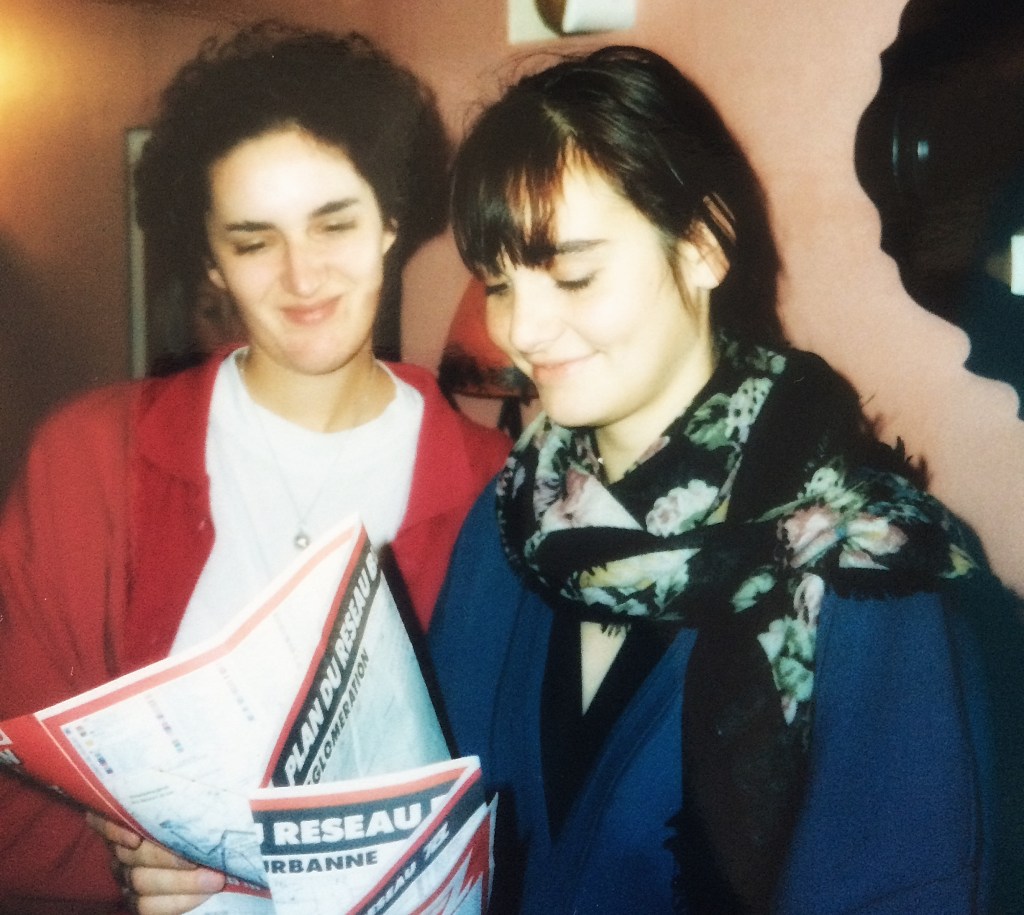
    Anne reading a map preparing me for a tour of Lyon

    Anne reading a map preparing me for a tour of Lyon

    What strikes me about Anne is her ease and grace. She is patient, kind and always willing to help. It is through her that I met ‘Vinaigrette Claudie’, my landlady in Avignon – this introduction set me up for one of the best years of my life. Ashamedly, I’ve lost touch with Anne, something I hope to redress (she lived in Lyon, so if you know her, drop me a line).

    The enduring image I have of Anne is a picture she sent me of her autumn wedding – elfin, graceful and demure.

    Anne’s recipe is not a traditional dauphinois, as it has cheese and onion in it. I’ve tweaked the method to bring in the more traditional way of cooking the potatoes.

    Music to prepare this to: ‘Don’t speak’ by No Doubt

    Ingredients

    • 1kg Potatoes, peeled and sliced. Make sure the slices are thin and even (try 3mm)
    • 2 Onions finely diced
    • 300g Strong cheese, grated (I prefer Apfenzeller but good cheddar will do)
    • 800ml Whole milk
    • 200ml Double cream
    • 2 cloves of garlic, crushed
    • 1 Bay leaf
    • I Sprig of thyme
    • Salt & pepper

    Method

    1. Line up your prepared ingredients – this dish is all about assembly.
    2. Preheat your oven to 180C.
    3. Put the milk in a pan with the bay leaf and the sprig of thyme, and a little salt and pepper. Bring to the boil and add the potatoes. Cook very gently on a low heat for about 15-20 mins. The potatoes need to have bite to them still.
    4. Strain the potatoes (keep the milk but discard the bay leaf and thyme).
    5. Now it’s time to assemble: in a lasagna dish, add a layer of potatoes, a smattering of onions, a sprinkle of cheese, a little garlic and a dusting of salt and pepper.
    6. Repeat until the dish is full, ensuring the top layer is covered in cheese.
    7. Pour the cream into the dish and top up with the milk. The liquid should just touch the top layer (but not cover it).
    8. Bake at 180C for 30 to 40 min.
    9. This is the important bit, leave it to stand for around 45mins. It won’t go cold but it will settle down nicely.

    This is a great alternative to Mum’s roast potatoes if you’re tight for oven space.

  • Alessandra’s peppery salmon gnocchi

    Alessandra was our Italian flatmate in my final year of uni at Liverpool – she was the sea of calm in a decadent household in Toxteth. She kept herself largely to herself, was quiet and demure until her boyfriend arrived. Then no amount of doors, floors and ear plugs could stop you hearing her.

    salmon_pasta

    Peppery salmon gnocchi – not a stunner to look at but a real blinder to taste

    My diet at this time was polish Kielbasa sausage, beer and chips. Alessandra showed me this dish when I was hungover and woefully helpless. It’s simple, effortless and tasty and has only four ingredients. It doesn’t look the prettiest so you can either serve it from the pan in to coloured bowls of dress it up with a few bits of basil.

    I hadn’t cooked this in a fair few years and it came to mind when I needed an emergency food fix for Jarod. This was just the trick – it takes less than ten minutes to make.

    The below could serve six, realistically it serves four. Gnocchi is stodgy, this works equally well with tagliatelle.

    Music to prepare this dish to: ‘Ride on time’ by Black Box 

    Ingredients

    • 200g Full fat mascarpone
    • 200g smoked salmon, hand torn to make cooking through easier
    • 1 to 1.5tsp ground black pepper
    • 350g gnocchi (you can also use pici, tagliatelle or strozzapreti)

    Method

    1. Set a pan of salted water on the boil.
    2. In a large pan, heat the mascarpone over a low heat.
    3. Once loosened, add the salmon and the pepper and stir till the salmon has cooked through. Taste and season with salt if need be – the amount you need, if any, depends on your salmon.
    4. Remove the salmon mix from the heat and cook your gnocchi. I always under do it by 30 seconds as it finishes cooking in the sauce.
    5. Strain the gnocchi and add to the salmon mix. Stir through till all pieces are covered and serve immediately.

    I like this kind of rich dish with an incisive white. I love Swiss wines, and 2007 Cave de la côte,  Oenoline la Côte works a treat (don’t get young Swiss wines… you’ll regret it)

  • Pug’s savoury grilled cheese

    This is my go-to comfort food/hangover (which is increasingly becoming my weekend default state) snack and is not really a recipe, more an assembly. I like bold tastes, I like crunch (the crispy fried bread and the crunchy peanuts give this) and above all else I love melted cheese. If you have allergies or a penchant for the bland, then move on, this isn’t for you.

    chip

    I’ve always loved food, especially fried food… especially chips.

    The key to success with this is the bread – over the years I’ve tried everything from bloomers to farmhouse and have settled on sourdough bread. Whatever your choice just make sure it’s not too holey and is medium thickness. Also, don’t try and fancy this one up – use ingredients you’d use every day.

    Music to prepare this dish to: ‘I ain’t been licked’ by Diana Ross

    Ingredients

    • 2 slices sourdough bread buttered on one side
    • Enough grated mature cheddar cheese to create a loaded sandwich, a really loaded sandwich
    • Marmite
    • One handful dry roasted peanuts
    • Vegetable oil for frying

    Method

    1. Assemble your sandwich: on one slice add the peanuts to the buttered side of the bread and top with the cheese.
    2. On the other slice, spread a thin layer of Marmite on the buttered side and close your sandwich.
    3. In a frying pan, over a medium flame, heat up enough oil to lightly cover the pan.
    4. Once warm, it’s time to fry your sandwich. When frying, push down on the sandwich with a spatula. You can give it some welly
    5. After 4 mins it should be golden brown, so flip and cook the other side for the same amount of time. Keep pressing with the spatula.

    Once done, cut in half and serve with a cup of builder’s tea.